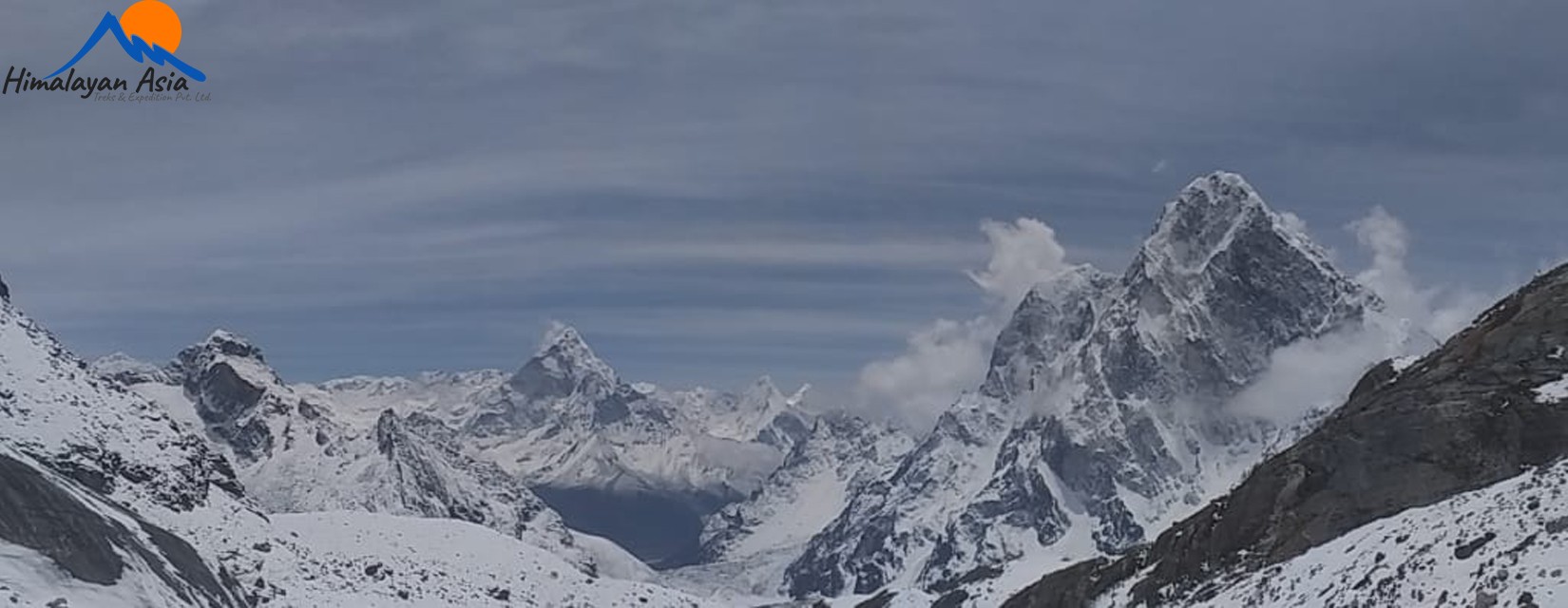
About Everest High Pass Trek | Three Passes Trek in Everest 2026
Everest Three Passes Trek: Complete Guide to the Everest High Pass Trek in Nepal
The Everest Three Passes Trek, also known as the Everest High Pass Trek, is one of the most adventurous and rewarding trekking routes in the Everest region of Nepal. Instead of following only the traditional Everest Base Camp trail, this challenging circuit crosses three spectacular Himalayan passes: Renjo La, Cho La, and Kongma La.
The route combines the best of the Khumbu region—Everest Base Camp, Kala Patthar, Gokyo Lakes, Gokyo Ri, remote Sherpa villages, glaciers, high mountain passes, Buddhist monasteries, and spectacular views of Mount Everest, Lhotse, Makalu, Cho Oyu, Ama Dablam and Nuptse.
The current Himalayan Asia Treks itinerary is designed as a 20-day / 19-night journey, with a maximum elevation of approximately 5,545 meters at Kala Patthar. The itinerary also includes acclimatization in key high-altitude locations.
For trekkers who want more than the standard Everest Base Camp experience, the Three Passes Trek offers a much broader journey through the high Himalayas.
What Is the Everest Three Passes Trek?
The Everest Three Passes Trek is a challenging high-altitude trekking circuit in Nepal that crosses Renjo La, Cho La and Kongma La and combines the Gokyo Valley, Everest Base Camp and Kala Patthar in one extended Himalayan adventure.
The three major passes are:
| High Pass | Approximate Elevation |
|---|---|
| Renjo La Pass | 5,400+ m |
| Cho La Pass | 5,400+ m |
| Kongma La Pass | 5,500+ m |
Exact elevations can vary slightly between maps and sources, and snow conditions can significantly change the difficulty of individual crossings.
The route travels through the Sagarmatha National Park, a UNESCO World Heritage Site known for its dramatic mountain landscapes, glaciers, alpine terrain, Sherpa communities and Himalayan biodiversity.
Everest Three Passes Trek at a Glance
- Trek Name: Everest Three Passes Trek
- Also Known As: Everest High Pass Trek / Everest Three High Passes Trek
- Country: Nepal
- Region: Everest / Khumbu
- Duration: Around 18–21 trekking days depending on itinerary
- Himalayan Asia Treks itinerary: 20 days / 19 nights
- Starting Point: Lukla
- Major Passes: Renjo La, Cho La and Kongma La
- Main Highlights: Everest Base Camp, Kala Patthar, Gokyo Lakes, Gokyo Ri
- Maximum altitude: Approximately 5,545 m on the current itinerary
- Accommodation: Mainly teahouses and lodges
- Difficulty: Challenging
- Recommended for: Experienced and physically prepared hikers
- Best seasons: Spring and autumn
- Typical trekking days: Approximately 6–8 hours, with some longer and more demanding days
- Permits: Relevant trekking and protected-area permits must be arranged before the trek
The Everest region contains extensive high-altitude terrain and much of Sagarmatha National Park lies above 3,000 meters, making acclimatization an important part of any itinerary.
Why Is the Everest Three Passes Trek Special?
The standard Everest Base Camp Trek takes you to the famous base camp beneath Mount Everest. The Three Passes Trek goes considerably further.
Instead of simply walking to Everest Base Camp and returning along a similar route, the Three Passes route connects several valleys and high mountain landscapes.
You can experience:
1. Three Himalayan high passes
The defining feature of this trek is crossing three major passes:
- Renjo La
- Cho La
- Kongma La
Each pass provides a different perspective of the Everest region.
2. Everest Base Camp
The itinerary includes Everest Base Camp, one of the world's most famous trekking destinations.
3. Kala Patthar
Kala Patthar provides one of the classic viewpoints for Everest and the surrounding peaks. The current Himalayan Asia Treks itinerary reaches approximately 5,545 m here.
4. Gokyo Lakes
The Gokyo Valley adds a completely different landscape to the trek, with turquoise glacial lakes surrounded by high Himalayan peaks.
Nepal Tourism Board describes the Gokyo Valley as an area known for its glacial lakes and views toward Cho Oyu, Everest, Lhotse and Makalu.
5. Gokyo Ri
Gokyo Ri is another spectacular viewpoint and an important acclimatization destination.
6. Sherpa culture
The trail passes through traditional Sherpa settlements including Namche Bazaar, Thame, Gokyo, Tengboche and other mountain villages.
7. Remote Himalayan landscapes
Compared with the busiest sections of the classic Everest Base Camp route, parts of the Three Passes Trek take you into quieter valleys and more rugged terrain.
What Are the Three Passes of the Everest Trek?
1. Renjo La Pass
Renjo La is generally the first major high pass on the clockwise itinerary.
The route approaches Renjo La from the Thame and Lungdeng side before descending toward Gokyo.
The crossing provides spectacular views of the surrounding Himalayan ranges and connects the remote northern valleys with the Gokyo Valley.
The Nepal Tourism Board specifically identifies Renjo La as one of the high passes leading out of the Gokyo Valley and notes its connection toward the Thame area.
What makes Renjo La difficult?
The major challenges include:
- High altitude
- Long ascent
- Steep sections
- Cold temperatures
- Possible snow and ice
- Reduced oxygen
- Weather changes
2. Cho La Pass
Cho La connects the Gokyo Valley with the Everest Base Camp side of the Khumbu.
This is often considered one of the technically demanding sections of the Three Passes Trek, particularly when snow and ice are present.
The route from Gokyo passes through the Ngozumpa Glacier area before reaching the Cho La region and descending toward Dzongla.
The Nepal Tourism Board identifies Cho La as one of the principal high passes connecting the Gokyo Valley with the Khumbu Valley near Lobuche.
Why is Cho La challenging?
Trekkers should be prepared for:
- Steep terrain
- Rocky and uneven trails
- Glacial terrain
- Snow and ice depending on conditions
- Early-morning starts
- High altitude
- Strong winds and cold temperatures
This is one reason why experience and an appropriate itinerary are important.
3. Kongma La Pass
Kongma La is the third major pass on the classic Three Passes circuit.
The current Himalayan Asia Treks itinerary crosses Kongma La after the Everest Base Camp and Kala Patthar section, before descending toward Chhukung. The itinerary lists the pass at approximately 5,535 m.
This is one of the highest and most demanding points of the trek.
What makes Kongma La difficult?
The challenge comes from a combination of:
- Very high altitude
- Long trekking hours
- Steep ascents and descents
- Rocky and glacial terrain
- Possible snow
- Cold and wind
- Physical fatigue accumulated over previous days
A strong level of preparation is particularly important before attempting this section.
Everest Three Passes Trek Difficulty
How difficult is the Everest Three Passes Trek?
The Everest Three Passes Trek is a challenging high-altitude trek and is considerably more demanding than a standard Everest Base Camp itinerary.
The difficulty is not caused by one factor alone. It comes from the combination of altitude, long trekking days, steep terrain, high passes, changing weather and limited recovery opportunities.
Main factors affecting difficulty
Altitude:
Several sections are above 4,500 meters, with the three passes rising above 5,000 meters.
Distance:
The complete circuit requires many consecutive trekking days.
Terrain:
Expect rocky trails, moraine, steep slopes, glaciers and uneven surfaces.
Weather:
High Himalayan weather can change quickly.
Altitude sickness:
Acute Mountain Sickness can affect people regardless of fitness.
Recovery:
The body has less oxygen available at high altitude, so normal walking can feel much harder.
Can Beginners Do the Everest Three Passes Trek?
The Three Passes Trek is not an ideal first high-altitude trek for beginners.
Previous trekking experience is highly recommended, especially experience involving:
- Long walking days
- Mountain terrain
- Altitudes above 4,000 meters
- Cold-weather trekking
- Multi-day teahouse trekking
A trekker who has successfully completed routes such as Everest Base Camp, Annapurna Circuit Trek or another demanding high-altitude trek may be better prepared, although previous experience does not eliminate altitude-related risks.
Everest Three Passes Trek Route
The route can vary by itinerary, but the classic circuit generally connects:
Lukla → Phakding → Namche → Thame → Lungdeng → Renjo La → Gokyo → Thangnak → Cho La → Dzongla → Lobuche → Everest Base Camp → Kala Patthar → Kongma La → Chhukung → Tengboche → Namche → Lukla
This route provides a rare opportunity to experience several different sides of the Everest region within one trek.
Everest Three Passes Trek Distance
The exact distance depends on the chosen itinerary, side trips and route variations.
A complete Three Passes itinerary commonly involves approximately 140–150 km or more of walking, depending on the route and excursions.
Rather than focusing only on total kilometers, hikers should prepare for the number of consecutive trekking days, elevation gain and high-altitude terrain.
Everest Three Passes Trek Elevation Profile
Altitude is one of the most important considerations.
Some key elevations include:
| Location | Approx. Elevation |
|---|---|
| Lukla | 2,860 m |
| Namche Bazaar | 3,440–3,500 m |
| Thame | 3,800+ m |
| Lungdeng | 4,500 m |
| Gokyo | 4,790 m |
| Cho La | 5,400+ m |
| Everest Base Camp | 5,364 m |
| Kala Patthar | 5,545 m |
| Kongma La | 5,500+ m |
Altitude figures can differ slightly between maps, GPS devices and published itineraries.
Altitude Sickness on the Three Passes Trek
Altitude sickness is one of the most important safety issues on this trek.
Nepal Tourism Board warns that Acute Mountain Sickness can develop at high altitude and advises trekkers to understand altitude-related risks before travelling into high mountain areas.
Common symptoms of mild AMS
- Headache
- Dizziness
- Nausea
- Loss of appetite
- Unusual tiredness
- Poor sleep
How can trekkers reduce the risk?
- Ascend gradually.
- Follow the planned acclimatization days.
- Stay hydrated.
- Avoid excessive alcohol.
- Eat regularly.
- Walk at a comfortable pace.
- Tell your guide immediately if symptoms appear.
- Do not continue ascending if symptoms are getting worse.
The most important rule
Never try to "push through" worsening altitude sickness simply to complete a pass.
At high altitude, descending can be a critical part of treatment for serious altitude illness.
Is the Everest Three Passes Trek Safe?
No high-altitude trek can be described as completely risk-free.
However, risks can be reduced substantially through:
- Experienced guides
- Proper acclimatization
- Weather monitoring
- Appropriate equipment
- Conservative decision-making
- Adequate hydration and nutrition
- Travel insurance covering high-altitude trekking and emergency evacuation
- Emergency communication arrangements
Best Time for Everest Three Passes Trek
The two main trekking windows are:
Spring: March to May
Spring generally offers good trekking conditions, increasing daylight and impressive mountain views.
Lower elevations may also have blooming rhododendrons.
March can still bring snow to high passes, so conditions need to be checked before departure.
Autumn: September to November
Autumn is traditionally one of the most popular periods for trekking in the Everest region.
After the monsoon, visibility is often excellent and the mountain scenery can be spectacular.
October and November are particularly popular.
The Nepal Tourism Board identifies spring and autumn as important trekking periods in the Everest region.
Can You Do the Three Passes Trek in Winter?
Winter trekking is possible for experienced trekkers with appropriate preparation, but the Three Passes route becomes significantly more difficult because of snow, freezing temperatures and potentially difficult pass conditions.
High passes can become inaccessible depending on snowfall and weather.
For most trekkers, the main spring and autumn seasons provide a more practical window.
Can You Do the Three Passes Trek During Monsoon?
June through August is generally not the preferred period.
Rain, cloud, reduced visibility, slippery trails and transportation disruptions can complicate the journey.
The higher Everest region receives different weather conditions from lower Nepal, but high-pass trekking still requires careful seasonal planning.
Everest Three Passes Trek Permits
Permits and documentation should be arranged before starting the trek.
For the Everest region, trekkers need the appropriate Sagarmatha National Park entry permit and TIMS documentation, subject to current Nepal government regulations.
Nepal Tourism Board states that trekkers need TIMS documentation and protected-area entry permits for trekking routes in Nepal. Its current TIMS information also states that licensed trekking agencies can process TIMS online.
Accommodation During the Three Passes Trek
Most of the trek uses teahouse or lodge accommodation.
Typical facilities include:
- Twin-sharing rooms
- Dining areas
- Hot meals
- Tea and coffee
- Charging facilities in many locations
- Limited internet or Wi-Fi in some villages
- Shared bathrooms in many higher settlements
Facilities become increasingly basic as altitude increases.
At the highest settlements, trekkers should not expect city-style hotel facilities.
Food on the Everest Three Passes Trek
Teahouses generally serve a mixture of Nepali, Tibetan-style and international trekking foods.
Common choices include:
- Dal bhat
- Rice
- Noodles
- Pasta
- Soup
- Potatoes
- Eggs
- Bread
- Pancakes
- Porridge
- Momos
- Tea
- Coffee
Dal bhat is particularly popular because it provides a filling combination of rice, lentils and vegetables.
At high altitude, eating enough food is important because the body uses significant energy during long trekking days.
What Should You Pack for the Three Passes Trek?
A suitable packing list should include:
Clothing
- Thermal base layers
- Fleece layer
- Down jacket
- Waterproof jacket
- Trekking trousers
- Warm hat
- Sun hat
- Gloves
- Warm socks
Footwear
- Good-quality trekking boots
- Camp shoes or sandals
- Gaiters if conditions require them
Trekking equipment
- Backpack
- Sleeping bag suitable for cold temperatures
- Trekking poles
- Headlamp
- Water bottles
- Water purification tablets or filtration system
- Sunglasses
- Sunscreen
- Lip balm
- Personal first-aid supplies
Documents
- Passport
- Travel insurance documents
- Trekking permits
- Emergency contact information
- Copies of important documents
Electronics
- Phone
- Power bank
- Charging cables
- Camera if desired
At high altitude, lightweight but warm clothing is more useful than carrying excessive equipment.
Travel Insurance for the Three Passes Trek
Travel insurance should be treated as an essential part of planning.
Because the trek reaches above 5,500 meters, your policy should specifically cover:
- High-altitude trekking
- Emergency medical treatment
- Helicopter evacuation
- Trip cancellation
- Trip interruption
- Lost baggage
Do not assume that a normal travel insurance policy automatically covers high-altitude trekking.
Check the maximum altitude covered by the policy and whether evacuation by helicopter is included.
Who Should Consider the Everest Three Passes Trek?
The trek may be appropriate for hikers who:
- Have previous multi-day trekking experience
- Are comfortable walking 6–8 hours on mountain trails
- Have trained for steep ascents and descents
- Understand high-altitude risks
- Are comfortable with basic teahouse accommodation
- Can handle cold conditions
- Have enough time for acclimatization
- Are prepared to change plans because of weather
Who Should Avoid Rushing Into the Three Passes Trek?
Extra caution is appropriate for people who:
- Have no previous trekking experience
- Have not trained for long mountain days
- Are uncomfortable at altitude
- Have insufficient time for acclimatization
- Are unwilling to carry appropriate cold-weather equipment
- Expect hotel-level facilities throughout the route
Anyone with a medical condition that may affect high-altitude travel should discuss the trek with an appropriate medical professional before departure.
Everest Base Camp Trek vs Everest Three Passes Trek
One of the most common questions is whether to choose the standard Everest Base Camp Trek or the Three Passes Trek.
| Feature | Everest Base Camp | Everest Three Passes |
|---|---|---|
| Main goal | Everest Base Camp | Three high passes + EBC + Gokyo |
| Difficulty | Challenging | More demanding |
| High passes | No major three-pass circuit | Renjo La, Cho La, Kongma La |
| Gokyo Lakes | Not included | Included |
| Duration | Generally shorter | Generally longer |
| Remote terrain | Moderate | Extensive |
| Experience required | Moderate trekking experience useful | Previous high-altitude experience strongly recommended |
| Variety | Everest-Kala Patthar | Everest + Gokyo + high passes |
The Three Passes Trek is particularly attractive to trekkers who want to experience multiple sides of the Everest region rather than visiting Everest Base Camp alone.
Everest Three Passes Trek vs Gokyo Trek
The Gokyo Trek focuses primarily on the Gokyo Valley and its lakes, while the Three Passes Trek expands the journey across multiple high-altitude valleys.
The Nepal Tourism Board highlights Gokyo's glacial lakes and mountain viewpoints, as well as the Cho La and Renjo La connections with surrounding valleys.
Choose the Three Passes route if you want a more extensive circuit with several high passes.
Choose a Gokyo-focused itinerary if you prefer a shorter journey centered around Gokyo Lakes and Gokyo Ri.
What Are the Biggest Challenges of the Three Passes Trek?
The five biggest challenges are:
1. Altitude
Altitude is the most important factor.
2. High-pass crossings
Renjo La, Cho La and Kongma La all require serious preparation.
3. Long trekking days
Some days can involve 7–8 hours or more of walking.
4. Weather
Snow, wind, clouds and changing temperatures can affect high-pass crossings.
5. Physical fatigue
By the time trekkers reach the later passes, the body has already spent many days hiking at altitude.
How to Train for the Everest Three Passes Trek
Start training several weeks or months before your trek.
Cardiovascular training
Build endurance through:
- Hiking
- Running
- Cycling
- Stair climbing
- Brisk walking
Strength training
Focus on:
- Squats
- Lunges
- Step-ups
- Calf raises
- Core exercises
Hiking practice
The most useful preparation is regular hiking with a backpack.
Gradually increase:
- Distance
- Elevation gain
- Backpack weight
- Consecutive hiking days
The goal is not simply to become strong. It is to become comfortable walking for several hours on uneven terrain.
What Is the Hardest Day of the Three Passes Trek?
There is no universally hardest day because difficulty depends on weather, snow, acclimatization, fitness and individual response to altitude.
However, the days crossing Cho La and Kongma La are commonly among the most demanding sections because they combine high elevation with steep and technical terrain.
The current Himalayan Asia Treks itinerary schedules approximately seven hours for the Cho La crossing and approximately eight hours for the Kongma La crossing.
Is a Guide Necessary for the Everest Three Passes Trek?
A professional guide is strongly recommended for this route.
The benefits include:
- Navigation
- Altitude monitoring
- Weather awareness
- Emergency response
- Accommodation coordination
- Permit assistance
- Route-condition updates
- Communication with local teahouses
Why Trek the Everest Three Passes with Himalayan Asia Treks?
Himalayan Asia Treks organizes the Everest High Pass / Three Passes Trek with a focus on itinerary planning, acclimatization, local guides and trekking logistics.
The current package is designed around a 20-day itinerary and includes the major attractions of the Three Passes route, including Renjo La, Gokyo, Cho La, Everest Base Camp, Kala Patthar and Kongma La.
When selecting a trekking company, hikers should look for:
- Government registration
- Experienced local guides
- Clear package inclusions
- Transparent pricing
- Proper acclimatization
- Emergency procedures
- Insurance for staff
- Clear cancellation policies
- Reliable transportation arrangements
A responsible trekking company should also be prepared to modify the itinerary when weather or health conditions make a planned crossing unsafe.
Frequently Asked Questions About Everest Three Passes Trek
1. What is the Everest Three Passes Trek?
The Everest Three Passes Trek is a high-altitude circuit in Nepal's Khumbu region that crosses Renjo La, Cho La and Kongma La while also visiting Gokyo Lakes, Everest Base Camp and Kala Patthar.
2. How long does the Everest Three Passes Trek take?
Most complete itineraries take around 18–21 days, depending on acclimatization, route and transportation. The current Himalayan Asia Treks package is 20 days / 19 nights.
3. How difficult is the Everest Three Passes Trek?
It is a challenging high-altitude trek and is more demanding than a standard Everest Base Camp itinerary because of the three passes above 5,000 meters.
4. What are the three passes?
The three passes are:
- Renjo La
- Cho La
- Kongma La
5. What is the highest point on the Everest Three Passes Trek?
The current Himalayan Asia Treks itinerary reaches approximately 5,545 m at Kala Patthar, while Kongma La is approximately 5,535 m on that itinerary.
6. Is Everest Base Camp included?
Yes. The current Three Passes itinerary includes Everest Base Camp.
7. Are Gokyo Lakes included?
Yes. Gokyo is an important part of the classic Three Passes route, and the current itinerary includes an overnight stay and acclimatization in Gokyo.
8. Can beginners do the Three Passes Trek?
Beginners should generally consider gaining high-altitude trekking experience before attempting this route. The three passes make it substantially more demanding than many standard Nepal treks.
9. What is the best month for the Three Passes Trek?
The main trekking seasons are spring (March–May) and autumn (September–November). Autumn is especially popular for clear mountain views, while spring offers good visibility and blooming vegetation at lower elevations.
10. Do I need a permit for the Everest Three Passes Trek?
Yes. Trekkers need the applicable protected-area entry permit and TIMS documentation under current regulations. Requirements and fees can change, so verify the latest rules before departure.
11. Is altitude sickness a risk?
Yes. The route reaches above 5,000 meters, so altitude sickness is a serious consideration. Proper acclimatization and gradual ascent are essential.
12. How many hours do you walk each day?
Many trekking days involve approximately 5–8 hours of walking, although difficult pass-crossing days can feel considerably harder depending on conditions.
13. What type of accommodation is available?
Most nights are spent in teahouses or mountain lodges. Facilities become more basic at higher elevations.
14. What mountains can I see?
Depending on weather and viewpoint, trekkers can see:
- Mount Everest
- Lhotse
- Nuptse
- Makalu
- Cho Oyu
- Ama Dablam
- Cholatse
- Taboche
- Pumori
The Nepal Tourism Board highlights Everest, Lhotse and Cho Oyu among the major peaks of the Everest region.
15. Is the Three Passes Trek harder than Everest Base Camp?
Generally, yes, because it adds three high-altitude pass crossings and more remote terrain to the journey.
16. Can I do the Three Passes Trek without a porter?
Some experienced trekkers may choose to carry their own equipment, but carrying a heavy backpack at high altitude can significantly increase fatigue. A porter can make the trek more manageable.
17. Is there Wi-Fi on the trek?
Wi-Fi or mobile connectivity may be available in some villages, but connectivity is not guaranteed, particularly in remote and high-altitude sections.
18. Can I charge my phone?
Charging is available in many teahouses, sometimes for an additional fee. Carrying a power bank is recommended.
19. What happens if a high pass is closed because of snow?
A responsible trekking itinerary should prioritize safety. The guide and trekking company may modify the route, wait for safer conditions or use an alternative route depending on the circumstances.
20. Is travel insurance necessary?
For a high-altitude trek reaching above 5,500 meters, comprehensive travel insurance with appropriate high-altitude trekking and emergency evacuation coverage is strongly recommended.
Final Thoughts: Is the Everest Three Passes Trek Worth It?
The Everest Three Passes Trek is much more than an alternative route to Everest Base Camp.
It is a complete journey through the high Himalayas—connecting Gokyo Lakes, Renjo La, Cho La, Everest Base Camp, Kala Patthar and Kongma La while passing through traditional Sherpa communities and some of Nepal's most dramatic mountain landscapes.
The trek demands preparation, patience and respect for altitude. It is not a route to rush.
For experienced hikers who have enough time and want a comprehensive Everest-region adventure, the Three Passes route provides an opportunity to experience the Khumbu from several different perspectives rather than following only the classic Everest Base Camp trail.
Plan your Everest Three Passes Trek around acclimatization, weather, fitness, permits and safety—not simply the number of days.
Himalayan Asia Treks can help organize the route, guides, permits, accommodation and trekking logistics so that you can concentrate on experiencing the Himalayas.